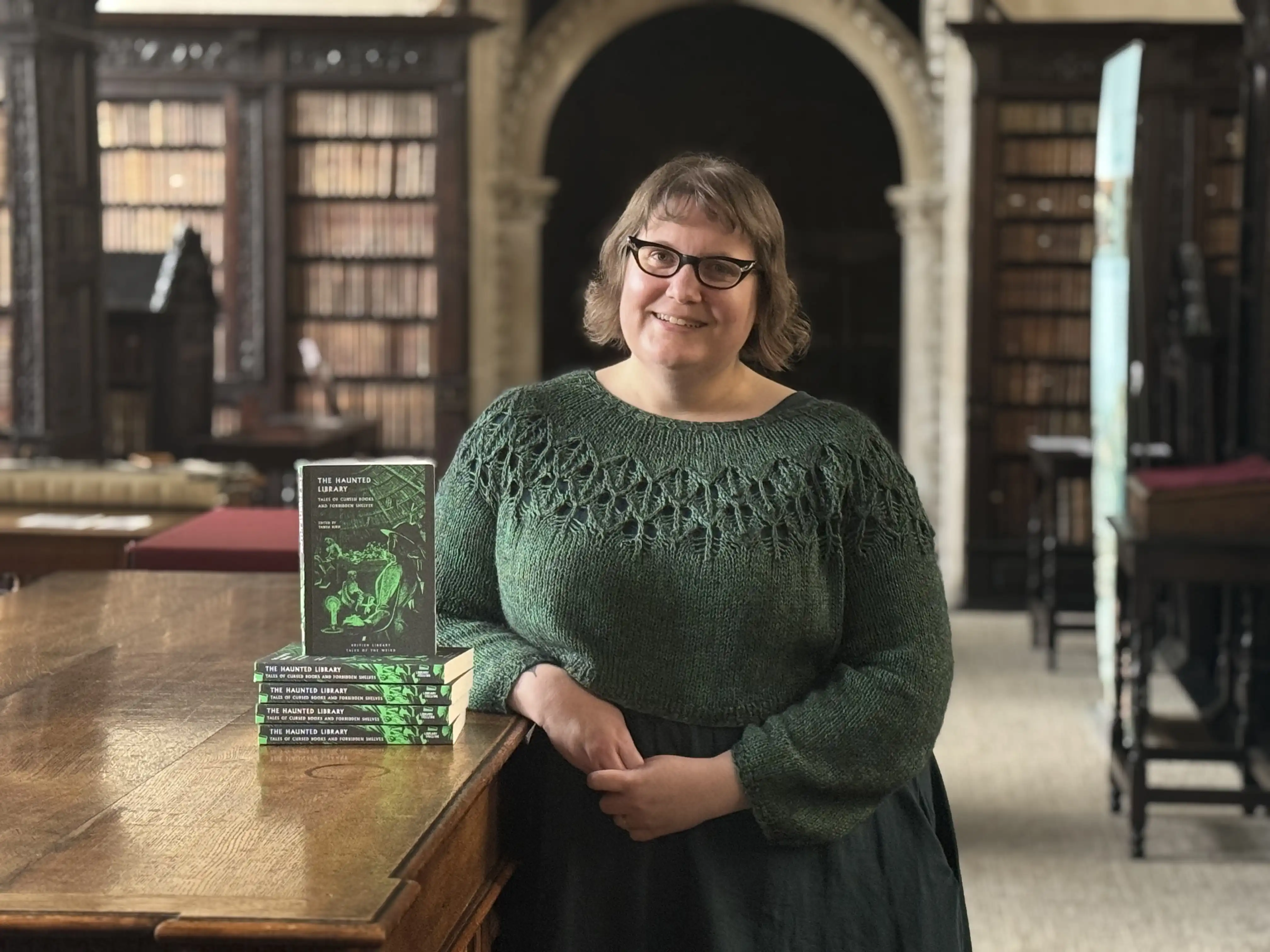
Working in a Cambridge college steeped in history and spectres from the past, it is unsurprising St John’s Librarian Tanya Kirk should be drawn into horror fiction to conjure up tales of the unexpected.
Her new book, The Haunted Library: Tales of Cursed Books and Forbidden Shelves, is inspired by the legendary Cambridge storyteller MR James and brings together 14 familiar, forgotten and new ghost stories themed around books, manuscripts and antiquarianism.
“People have a fascination with the afterlife,” said Kirk, a Fellow of St John’s. “The popularity of spiritualism and ghost stories from writers such as Charles Dickens and MR James in the mid- to late 19th century coincided with the beginnings of modern science. People were reacting against this idea that everything had to be rational.”
The Haunted Library was originally published in a different version in 2016, when Kirk was working at the British Library, to accompany the 'Terror and Wonder: The Gothic Imagination' exhibition.
The new edition has been expanded and contains a new introduction, a more varied range of stories, author biographies and editor’s notes. It is released as part of the British Library’s monthly Tales of the Weird series, for which Kirk has previously edited four Christmas collections.
“People had been telling scary stories for centuries, particularly in the wintertime, but as a literary phenomenon it took off because of fiction magazines in the 19th century,” said Kirk.
“They were cheap publications taking advantage of new mass production print technology and a new middle-class readership, and usually contained long serialised stories – essentially early soap operas. Editors included standalone pieces as well and ghost stories became popular features because they work well as short stories.
“The authors were often women making a modest living through penning these stories – it was a way of scraping by as a writer if they weren’t part of the literary establishment.”
As well as stories unearthed from 100-year-old periodicals, the collection includes classics from MR James, LP Hartley and Mary Webb, and horror from present-day author Penelope Lively.
A short story set in St John’s, The Advent Visitor, was written by Cambridge academic and St John’s graduate Dr Christina Faraday.

It was MR James, author, medieval scholar and Provost of King’s, who established the tradition of telling a ghost stories in his college rooms on Christmas Eve in the 1890s.
“People like ghost stories at Christmas because they enjoy the subversion of cosy domesticity,” said Kirk. “Virginia Woolf wrote that ‘it is pleasant to be afraid when we are conscious that we are in no kind of danger’. They provide escapism that’s a little different to how we usually think of that term, but it’s no less effective.
“James’s stories were themed around the world he was in – they often focus on a particular kind of bookish scholar, like himself or some of his Cambridge friends. Many academics and librarians were inspired by him to write their own stories, including ANL (Tim) Munby, who’s also in this volume and became the Librarian at King’s.”
Munby began writing ghost stories for the camp magazine while a prisoner-of-war in Germany in the Second World War.
“James was telling stories around the fire to frighten people at Christmas and Munby was telling them to comfort soldiers in the prisoner-of-war camp,” said Kirk.
The Penelope Lively story ‘turns the MR James style on its head’, said Kirk. “In the Jamesian tradition, scholarly men accidentally look in a manuscript and uncover some kind of untold horror from the past.
“In Lively’s story the main character is a female academic, and she starts to realise she’s being haunted by a woman she perceives as lowbrow and unintellectual. She begins turning into this woman and losing her sense of herself as a scholar – and that’s the source of fear.”
Dr Faraday’s tale set in St John’s where she was a student is also directly influenced by the MR James tradition. “It shows that these types of stories, written more than 100 years ago, still have resonance today – particularly at somewhere like St John’s where we are surrounded by the traces of the past,” added Kirk.
·Ìý is published in paperback on Thursday 13 November.