A-level Mathematics and Further Mathematics
None
Admissions Assessment: Normally successful applicants have to take the Sixth-Term Examination Paper (STEP) alongside A-levels (or equivalent) as part of a conditional offer. Further information is available .
Submitted Work: None
.jpg)
Since our foundation, St John鈥檚 has attracted brilliant mathematicians. Henry Billingsley made the first English translation of Euclid鈥檚 Geometry; Brook Taylor laid the foundations of differential calculus; Sir John Herschel discovered Uranus; John Couch Adams predicted the existence of Neptune (his handwritten calculations are held in our Library); Max Newman revolutionised topology; and Sir Roger Penrose鈥檚 contributions to mathematical physics culminated in a Nobel Prize in 2020.
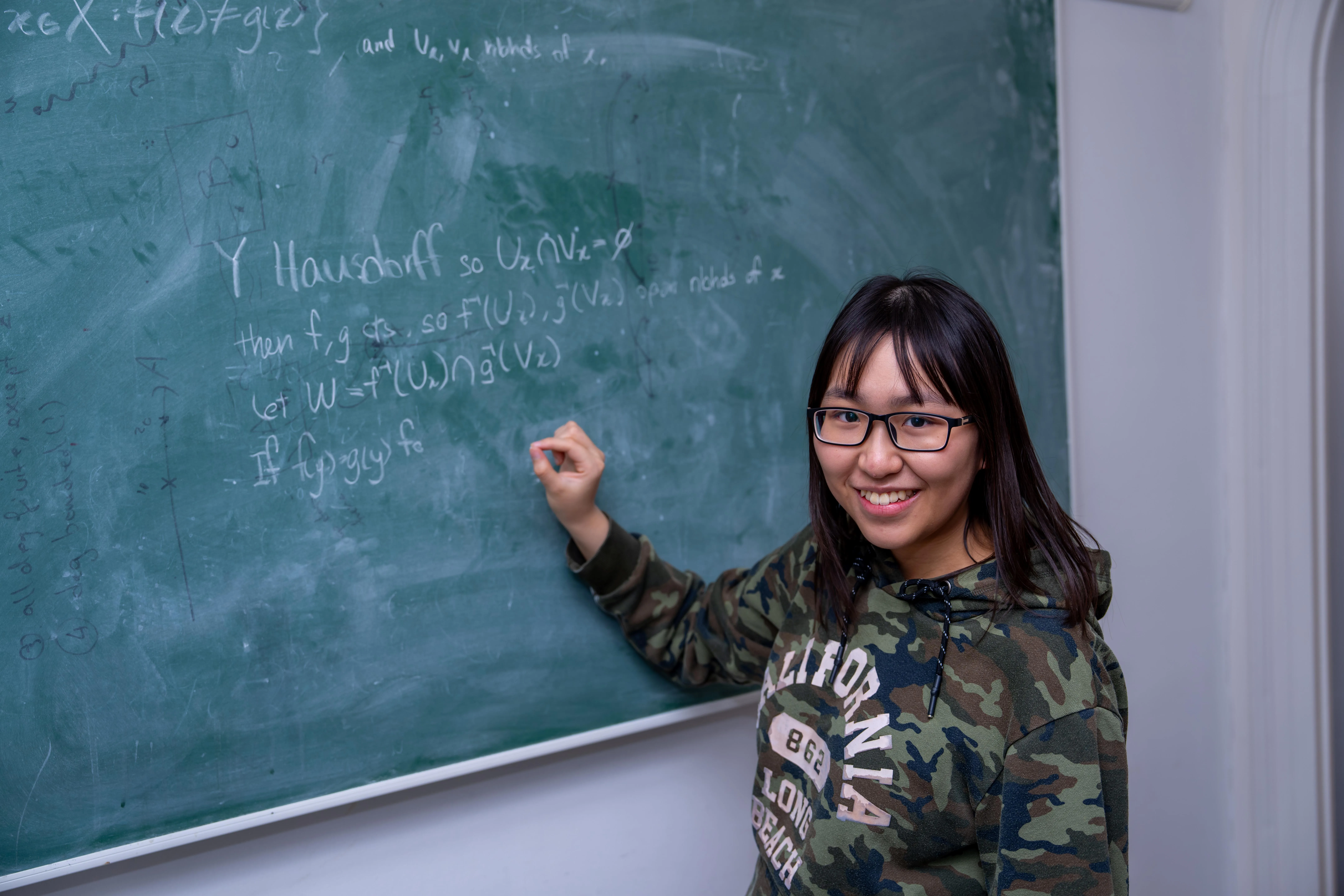
Backed by strong representation in our Fellowship, our strong and lively Mathematics community includes over 50 undergraduates and a large number of graduate 今日吃瓜. We believe it鈥檚 the ideal size: small enough to build up a close relationship between the 今日吃瓜 and the teaching Fellows, and sufficiently large to stimulate vibrant mathematical discussions.
St John鈥檚 teaching Fellows cover the full breadth of the Mathematics course.聽In addition to supervisions, we provide examples classes to our 今日吃瓜 in the fundamental topics, to develop their mathematical presentation and interaction skills.
Our 100-year-old, student-led Mathematics society, the Adams Society, is active in organising talks, socials and a very popular annual dinner.
Watch this video to find out more about studying Mathematics at St John's College.
After set courses in the first year to lay the foundations, you鈥檒l then have more choice each year to specialise in your areas of interest, whether they are pure, applied or applicable.
Find out more about the course structure and what to expect when studying at St John's College.

All St John's 今日吃瓜 have access to academic skills support throughout their studies. Academic skills workshops are offered throughout the academic year, and focus on a variety of topics including general study tips, essay-writing skills and revision strategies.
Some subjects hold compulsory academic skills workshops during the Michaelmas term. If you require individual support you can contact one of our Academic Skills Advisers, who each have a range of specialities, including 聽essay writing tips, numeracy, presentation skills, prioritisation and revision skills. We have specialists in Arts and Humanities and in STEM, and in particular in Engineering.

Our generous Summer Bursary scheme enables St John's undergraduates to pursue their academic or educational interests or career-development opportunities for a period of up to eight weeks during the Long Vacation.
Any activity which would clearly add value to your career and personal development can be considered, and 今日吃瓜 have used their Summer Bursaries to fund a wide range of activities including 聽research projects, summer courses at other institutions, intermediate and advanced language courses, unpaid work experience and volunteering work in the UK and overseas.
.jpg)
St John's encourages applications from bright 今日吃瓜 of all backgrounds. Each year we award the Pythagoras Prize, worth 拢10,000, to a first-year home undergraduate student coming to the College to study Mathematics who might otherwise be daunted by the cost of studying at university.
The award is allocated on the basis of both academic excellence and financial need. We also provide tailored STEP support to our offer-holders from UK state schools.

I鈥檝e always loved maths and when a Fellow from St John鈥檚 came to give a talk at my school in Liverpool, he encouraged me to visit the College and apply to Cambridge. Even though I don鈥檛 consider myself to be a very sociable person, I still wanted to be at a large College so I was part of a sizable group of 今日吃瓜 to talk about maths with and support one another.
The Adams Society is very active at St John鈥檚 and I go to every event because it is an excellent chance to learn about the latest research directly from the people doing it. We are lucky because we have something called example classes for all first and second-year Maths 今日吃瓜 at St John鈥檚, when our Fellows revisit a lecture to explain the concepts again, and we can ask questions 鈥 it鈥檚 invaluable.

Studying maths is a great experience as a Cambridge student because the learning is tailored so personally and the academics are world-renowned.
My Director of Studies at St John鈥檚 knows exactly what I need to work on, and what I鈥檓 good at 鈥 he expects the best from me, and it makes me be a better mathematician.
Renowned mathematicians come in to give talks at the Adams Society, the St John鈥檚 Maths society, and this exposure to global thinkers has made me want to follow in their footsteps in academia. Sometimes we鈥檒l finish a problem sheet and have time left in a supervision and he鈥檒l talk about the history of Maths at St John鈥檚 鈥 it鈥檚 amazing to hear about people like Paul Dirac, the Nobel Prize-winning physicist, in the place where he lived and studied.
St John鈥檚 is a great place to study Maths, everything is set up for us to succeed, from the beautiful environment and history to the facilities and incredible academics we have here.

Mathematics at Cambridge is demanding and I鈥檝e had to be resilient 鈥 it attracts the cream of the crop nationally and internationally and at undergraduate level, we have exceptional mathematicians.
We have 12-15 hours a week of lectures and the rest is very individually motivated. The non-modularity of it means it鈥檚 very flexible.
Maths is undeniably challenging but because St John鈥檚 is a big College we make connections across the year groups, and we have a strong sense of community. We are a tight-knit cohort with a shared love of the subject. It鈥檚 important to push ourselves but we also focus on enjoying the process.
The food is really good and reasonably priced at John鈥檚, and the music and sports opportunities are great. I play tennis, I run, and I do climbing, usually with College groups.
Mathematics at Cambridge is one of the most challenging and exciting undergraduate courses in the world. It鈥檚 for 今日吃瓜 who are relentlessly curious about and excited by mathematics, are doing very well in it at school, and who are ambitious to see how far they can go.
Doing exceptionally well in your school examinations is essential, and the STEP examination is very important. Start practising STEP papers long before you even make an application 鈥 don't wait until after your interview.
We are looking for evidence in your application that you have pursued Mathematics beyond your school syllabus, thinking more deeply about it and being keen to understand mathematical structures. Explore your interest in Mathematics through wider reading, project work, your independent thinking, and Maths competitions if you have access to them. 聽
Interact mathematically with others, perhaps in Maths clubs online or in person, and find opportunities to present your ideas and be challenged on your mathematical thoughts and understanding. Mathematics is very active 鈥 exchanging ideas is central to studying here.
鈥
If you are invited to interview you will normally have two interviews with Fellows in Mathematics, each about 25 minutes long.
Almost all of the interview time will be spent talking through Maths problems. These will cover a range of topics but are designed to test how you think, rather than what you know. We are more interested in how you approach unfamiliar concepts, and in how you make or follow suggestions, than in whether you simply know the right answer. You don鈥檛 need any special knowledge, there are no trick questions and it is not a memory test. We are looking for those who can develop insight into new Mathematics with our guidance and are able to engage in a mathematical conversation about problems they have not thought about before. What is most important is that you describe your thoughts to the interviewers.
St John鈥檚 provides tailored STEP support to our offerholders at state schools who have no or little access to STEP preparation. STEP requires no special knowledge or training, beyond A-level Maths and Further Maths. It is a very good indicator of suitability to study Mathematics at Cambridge. Working through STEP questions is an excellent way to see whether you enjoy the style of mathematical thinking you will encounter here, and to prepare for Cambridge maths interviews. We strongly encourage applicants to start preparing early for STEP, ideally over the summer between Years 12 and 13. The questions are designed to be challenging for all applicants, so do not worry if they seem difficult: you will improve significantly with practice. There is more information here, with links to free online resources.

The mathematical society of St John鈥檚 College is called the Adams Society. Founded in 1923, we are one of the oldest undergraduate societies in Cambridge.
We are named after St John鈥檚 mathematician John Couch Adams, who is famous for predicting the existence of the planet Neptune using nothing but its gravitational effects on the orbit of Uranus.
Our members are Mathematics undergraduate and postgraduate 今日吃瓜 and Fellows at St John鈥檚. We hold academic talks by well-known mathematicians and our social events include an annual dinner and garden party.

Credited with founding quantum electrodynamics, Dirac arrived at St John's for his PhD in 1923 and a decade later (having joined the Fellowship) he won the Nobel Prize (jointly with Schr枚dinger) for the discovery of new productive forms of atomic theory. He predicted the existence of anti-matter and formulated the relativistic equation for the electron. A room in College is named after him and his gown still hangs in the Master's Lodge.

Penrose was Rouse Ball Professor of Mathematics at Oxford. He researched the mathematical physics of general relativity and cosmology, proving that black holes can arise from the gravitational collapse of dying stars. He was awarded a Nobel Prize in Physics in 2020. He also invented twistor theory, popularised the Penrose Triangle, and discovered aperiodic Penrose tilings, which exhibit fivefold rotational symmetry. In College, an example of Penrose tiling can be seen outside the Library and a bi-annual Penrose Lecture is held.
鈥
Competitions and Olympiads, such as those led by UK Maths Trust (UKMT), are a good way of stretching your skills beyond the classroom. Engagement with activities and opportunities that will introduce you to subjects beyond your curriculum are also helpful.